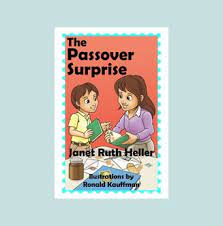
“The Passover Surprise” (Fictive Press 2015) is a delightful historical fiction written by Dr. Janet Ruth Heller. Children ages eight to twelve will enjoy reading it, and younger children will benefit from having it read to them with subsequent discussion. This six-chapter, forty-eight-page book contains nostalgic illustrations by Ronald Kaufman that immediately transport the reader to the book’s 1960’s setting. There is also a glossary and discussion guide at the back.
“The Passover Surprise” tells the story of twelve-year-old Lisa who enters a stamp collecting “contest” with her younger brother, Joe. The winner will receive a large stamp collection album from their father. Lisa wins the contest, but her father awards the stamp album to Joe because he believes stamp collecting is a hobby better suited to boys. This unintentionally causes Lisa a great deal of hurt, and she is angered by the unfair treatment. Lisa confides her feelings to her mother who gives the advice of Rabbi Hillel: “If I am not for myself, then who will help me?” What follows are Lisa’s attempts at reaching out, expressing her feelings in a positive way and being honest with her father. Lisa prays for a Passover miracle, and after the Seder she finds a wrapped stamp album on her bed. Her father tells his overjoyed daughter they can all share the wonders of stamp collecting.
Set against a joyful Passover celebration shared with extended family, “The Passover Surprise” emphasizes the importance of speaking up about unequal treatment wherever it might occur. The book illustrates the strength of family ties based on Jewish traditions and links generations together with holiday celebration and lessons drawn from Jewish faith.
Dr. Janet Ruth Heller is an award-winning author. She obtained her PhD in English from the University of Chicago and has taught many classes including literary fiction and women’s studies. Her passion for writing began early and was encouraged by a book-loving mother and an inspirational first grade teacher. Dr. Heller began writing “The Passover Surprise” in 1999 and developed it over the years with the help of her writers’ group, to whom the book is dedicated. She drew upon her own experiences including a love of stamp collecting shared with her father and brother. Her father arranged for a contest like the one in the book, and Dr. Heller felt the result was handled unfairly. Unlike the character of Lisa, Dr. Heller did not know how to express her frustration, and she never forgot the experience. She chose to set the book against the backdrop of Passover because of the memorable family celebrations of her childhood. In addition, Dr. Heller considers the change in the attitude of Lisa’s father represents a turning point in the father/daughter relationship just as the Exodus represents a turning point for the Jewish people. Dr. Heller believes the book’s most important theme is “…. that people combat unfair situations, calmly but bravely.” She hopes parents can also learn from “The Passover Surprise” by realizing that favoritism — intentional or not — can cause lasting harm to a child.
The book has a wonderful old-fashioned feel which I thoroughly enjoyed. This 1960’s setting is brought to life by the colorful illustrations and references to the television shows of the time (Lisa’s favorite show is “Father Knows Best”!). Lisa and her brother enjoy simple activities and appreciate the joy of each day. This type of joy is growing increasingly scarce in our modern world; kids tend to be over-scheduled and caught up in their computer games. I loved the book’s emphasis on not bottling up our feelings. Lisa reaches out to her mother and confides in a teacher and her best friend. She also looks to her extended family for examples of constructive behavior. Today’s world moves so quickly that sometimes it is difficult for people — especially kids — to reach out when they need help.
Dr. Heller is ambitious in the number of issues she tries to tackle. The book touches upon many examples of injustice including discrimination against women in the work force and African Americans during World War II. As important as these issues are, children might find them too numerous to process even though there is a common theme. However, the book’s emphasis on the importance of expressing one’s feelings (especially when a perceived injustice has taken place) teaches valuable lessons and can lead to productive discussions between parent and child.
Dr. Heller’s work and many wonderful endeavors can be followed on her website www.janetruthheller.com
This article was published in The Jewish Advocate on March 31, 2017.